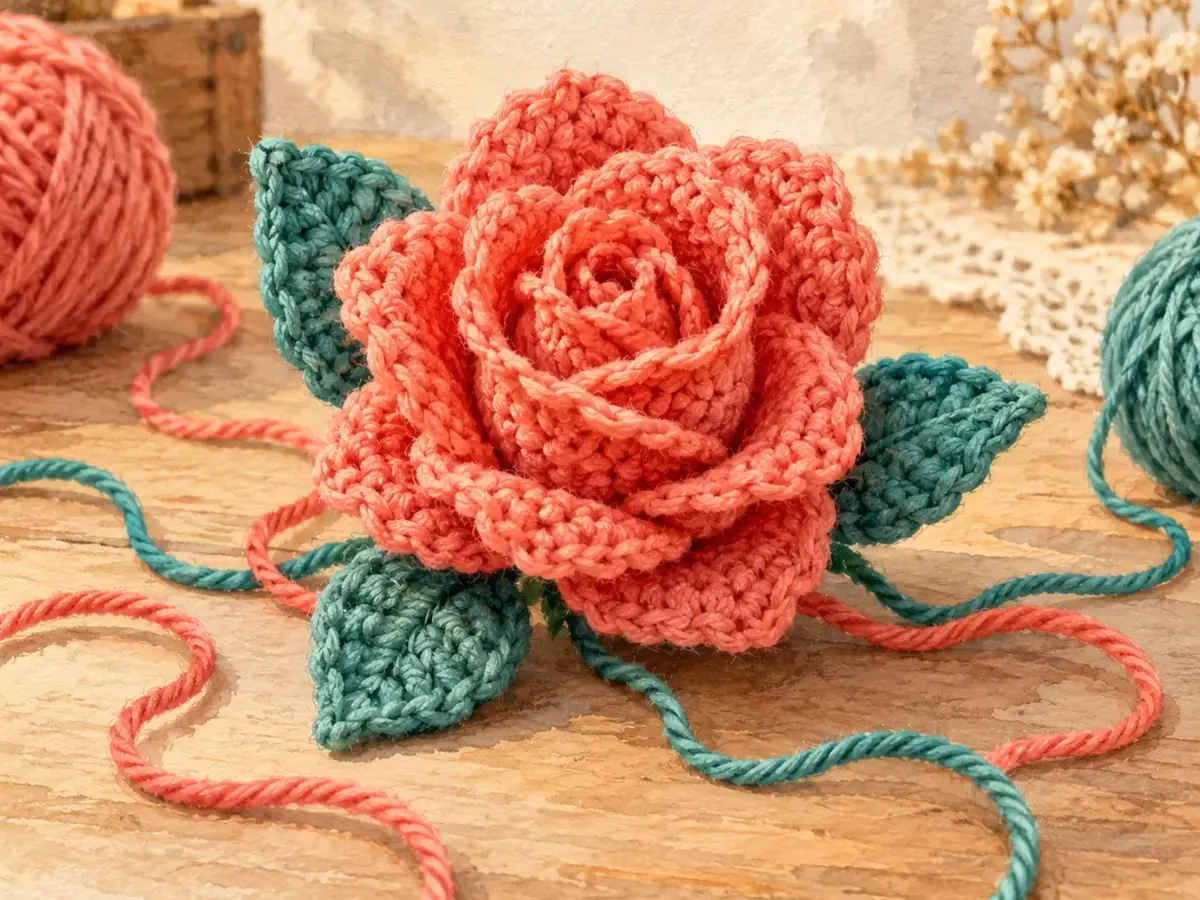
Several raised crochet stitches can look alike in a small photograph. The difference is how they are built: long drawn-up loops, unfinished stitches closed together, or completed stitches gathered afterward. Knowing that difference helps you read flower centres, textured petals and decorative borders.
In this guide
Three constructions to recognise / Try a small puff / Try a three-double-crochet cluster / Try a popcorn / Shells and picots / More textures in the reference
Three constructions to recognise
| Texture | Basic construction |
|---|---|
| Puff | Draw up several elongated loops, then close them together |
| Cluster or bobble variant | Work a specified group of unfinished stitches and close them together |
| Popcorn | Complete a group of stitches, then draw the last loop through the first stitch to gather them |
Names and closing chains vary between designers. Read the special-stitch definition, including how many loops or component stitches to make and whether the closing chain counts.
Try a small puff
At the chosen insertion point, yarn over and draw up a loop to the intended height. Repeat that movement twice more in the same place. You should have seven loops on the hook, including the original working loop. Yarn over and draw through all seven. Add a securing chain if the pattern calls for one.
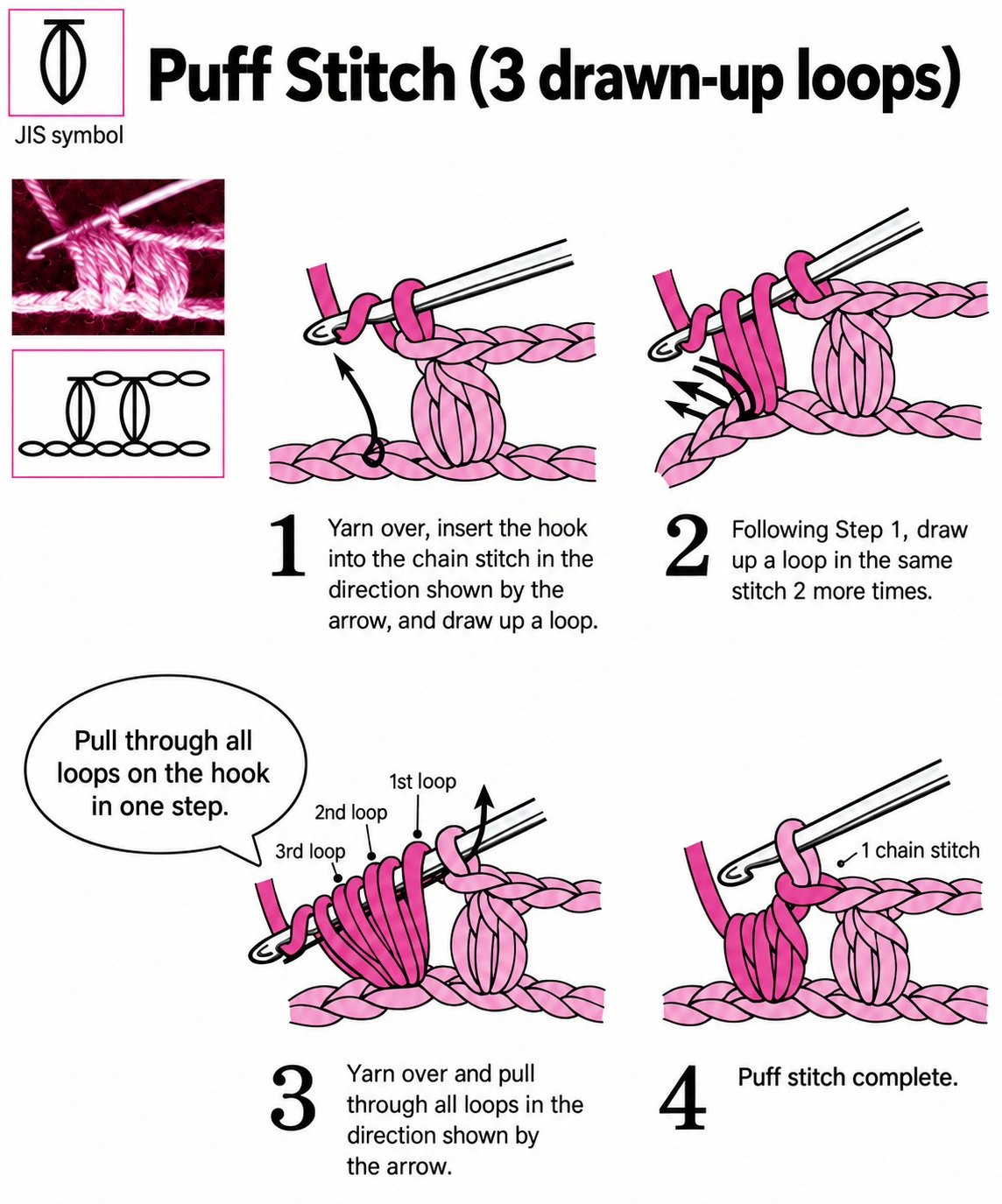
Keep the drawn-up loops at a similar height. Short, tight loops make the closing movement difficult; very loose loops can make the puff uneven. Practise on scrap yarn before placing it in a detailed project.
Try a three-double-crochet cluster
Begin a double crochet but stop before its final draw-through. Repeat twice in the same insertion point, leaving each stitch unfinished. Four loops remain on the hook. Yarn over and pull through them together.
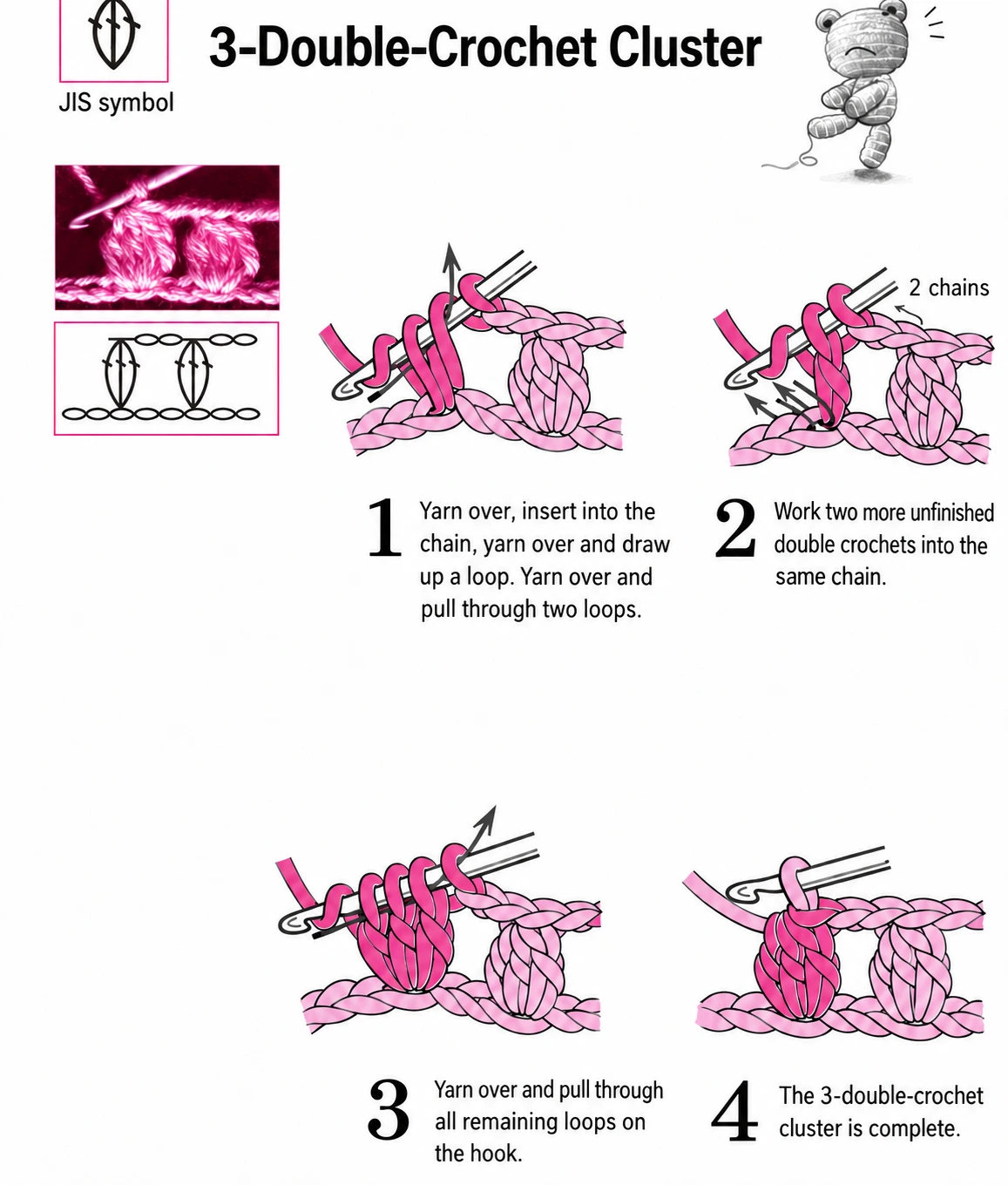
If the three unfinished stitches are spread across three different bases, the action instead brings those bases together. This is why the location of the symbol’s feet matters as much as its top.
Try a popcorn
Work five complete double crochets into one insertion point. Enlarge the working loop slightly and remove the hook. Insert the hook into the first double crochet, catch the dropped loop and pull it through. Follow the pattern for any closing chain.
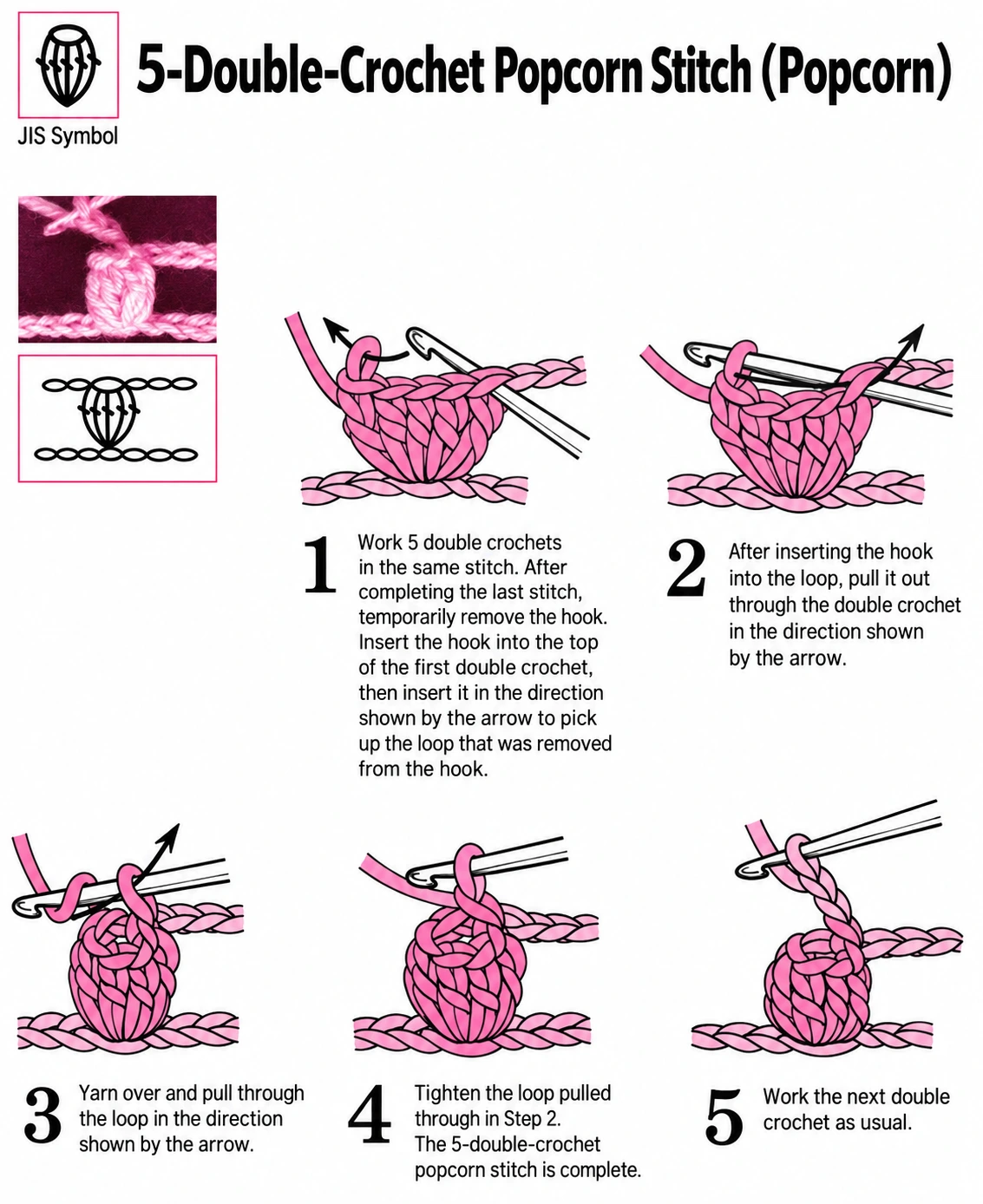
Unlike a cluster, those five double crochets were individually completed before being gathered. The supplied reference also shows popcorns made with other stitch heights and group sizes.
Shells and picots
A shell fans several completed stitches out from one base. A group such as “(2 dc, ch 1, 2 dc) in the same stitch” leaves a small chain space at its centre. On later rows, the pattern may ask you to work into that space rather than a stitch top.
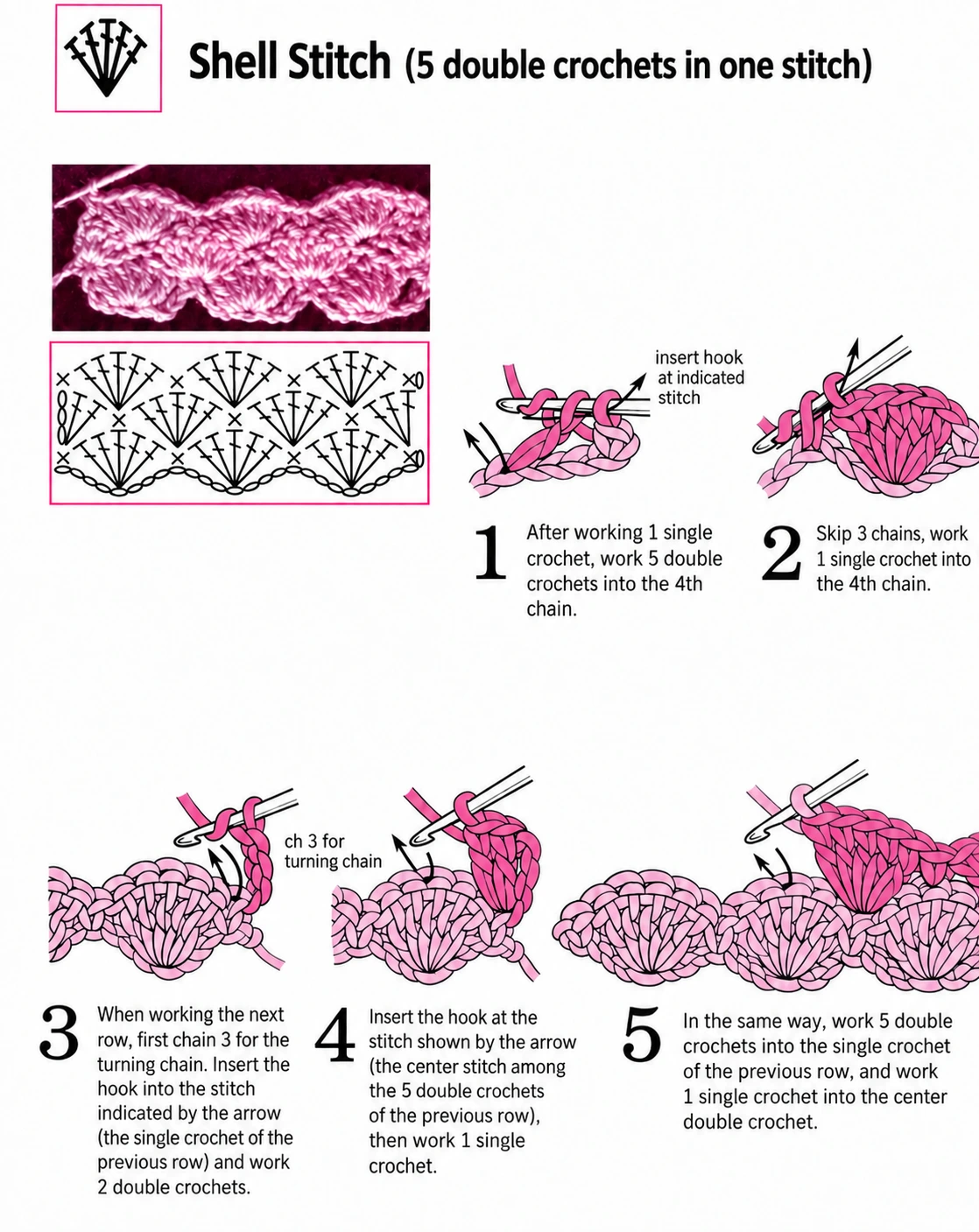
A picot makes a small point on an edge. A common version chains three and joins back with a slip stitch, but the exact join location must be stated. The reference charts show several picot variants; their star or triangle symbols are not interchangeable instructions.
More textures in the reference
- Crossed stitches change the order in which bases are worked. Keep track of the skipped base that the crossing stitch returns to.
- Loop stitches leave deliberate long loops on one face. Maintain a consistent loop length and do not cut loops unless the chosen method is intended for cut fringe.
- Reverse single crochet works back along an edge; for a right-handed crocheter this is commonly left to right.
- Filet and chain mesh combine solid stitches with planned spaces. Count spaces as well as posts.
- Tall Y-shaped stitches, bullion stitches and elongated-loop lace use specialised constructions. Their diagrams need their own full instructions rather than a guessed English label.
The letter Q is not enough to specify a texture. Confirm the component stitch, number of repetitions, insertion point and closing method.
Reference notes
Adapted from the texture-stitch and openwork sections of the supplied I Want to Learn Crochet (Chinese-language reference) and the advanced-letter chart. This guide groups the main constructions rather than reproducing every decorative variation.
Step illustrations and photographs are excerpts from the supplied reference materials credited below. In-image instructional text has been translated into English and the supplied images enhanced with AI assistance. The English captions explain the pictured actions. Select a step image to view it at full size.
Frequently asked questions
What is the difference between puff, popcorn and cluster stitch?
A puff draws up elongated loops and closes them together. A cluster leaves component stitches unfinished and closes their loops together. A popcorn completes the stitches first and gathers them afterward.
Why do texture stitches look different from one pattern to another?
Designers vary the stitch height, number of repeats, insertion point and closing chain. Follow the written definition beside the symbol.