A crochet pattern can describe the same stitch with a drawing, an English abbreviation or a letter used by a particular designer. Start by checking the pattern key. A familiar-looking letter does not always carry the same meaning from one pattern to another.
This guide translates the two Chinese reference charts into US crochet language. Keep it beside your pattern as a reading aid, especially when making flowers and amigurumi from Chinese instructions.
In this guide
Start with the six everyday stitches / Read increases and decreases as actions / Special letters need their own key / Translate a whole instruction / US and UK names / A quick reading routine
Start with the six everyday stitches
| Reference letter | Chinese name | US instruction |
|---|---|---|
| CH | 锁针 / 辫子针 | Chain, ch |
| SL | 引拔针 | Slip stitch, sl st |
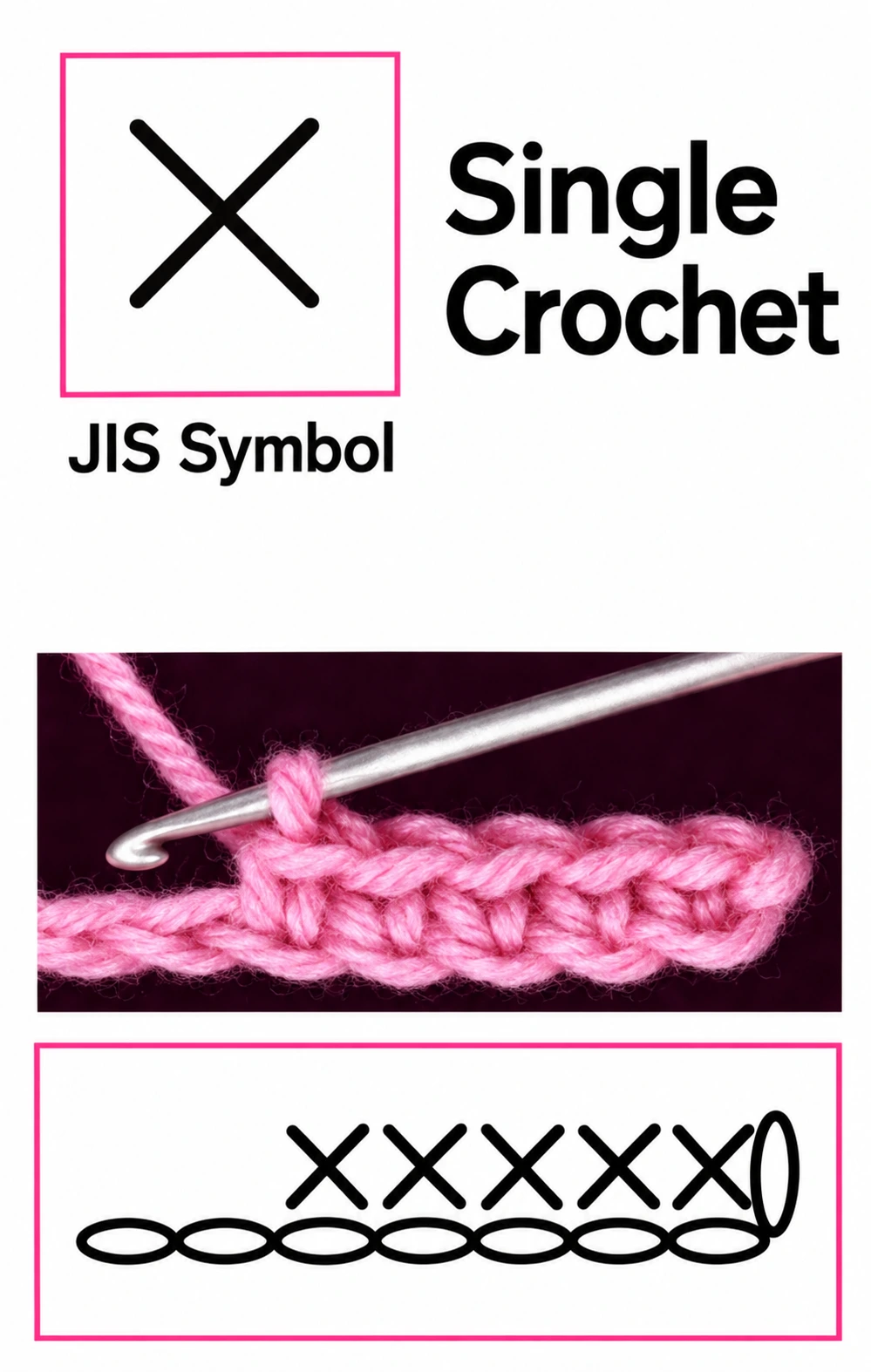
| X | 短针 | Single crochet, sc |
| T | 中长针 | Half double crochet, hdc |
| F | 长针 | Double crochet, dc |
| E | 长长针 | Treble crochet, tr |
The letter E here is a stitch label, not a hook size. Likewise, X is a shorthand used in these charts; an English written pattern normally uses sc.
Read increases and decreases as actions
| Reference | What to do | Change in stitch count |
|---|---|---|
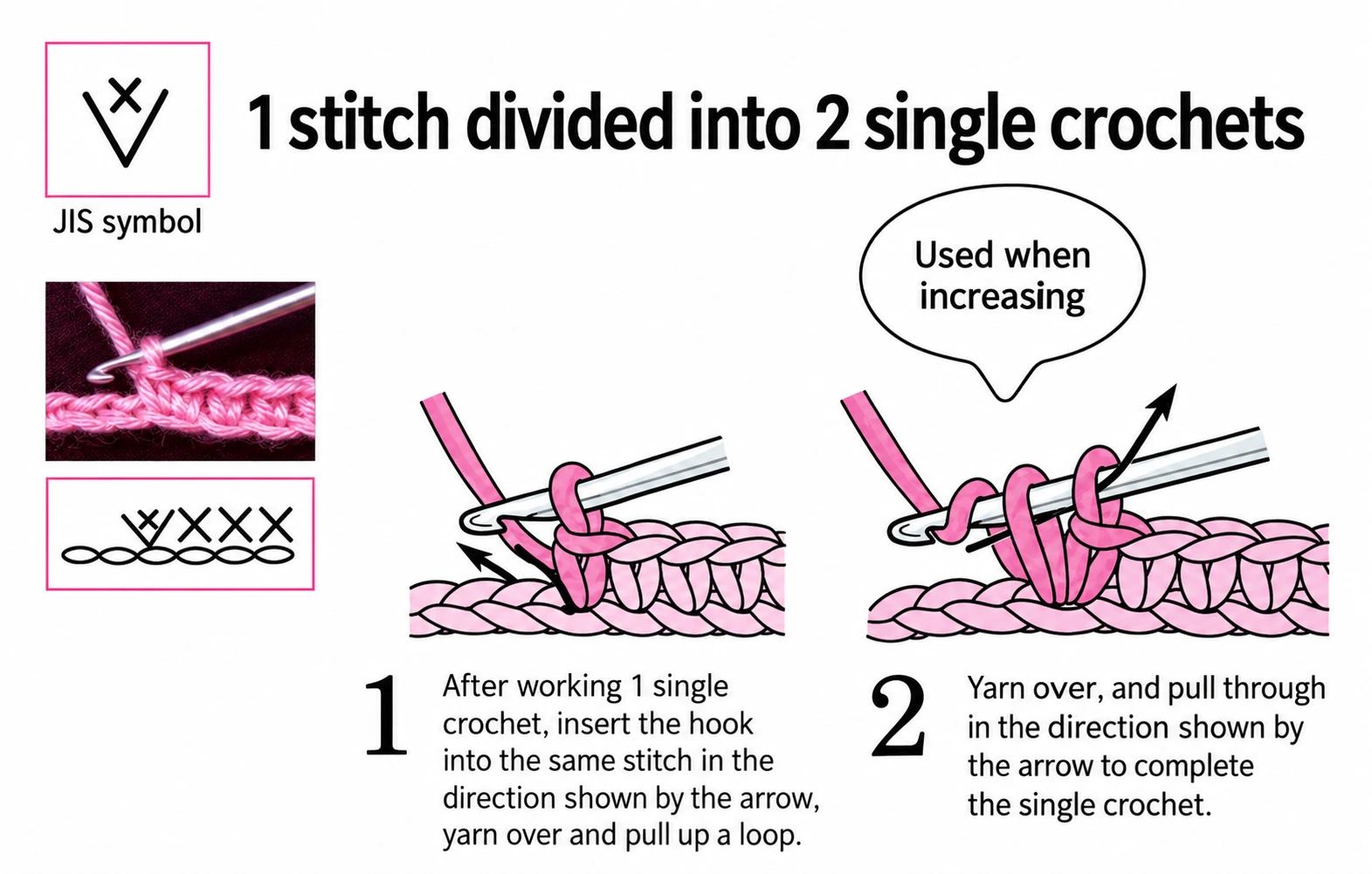
| V | Work 2 sc in one stitch | +1 |
| W | Work 3 sc in one stitch | +2 |
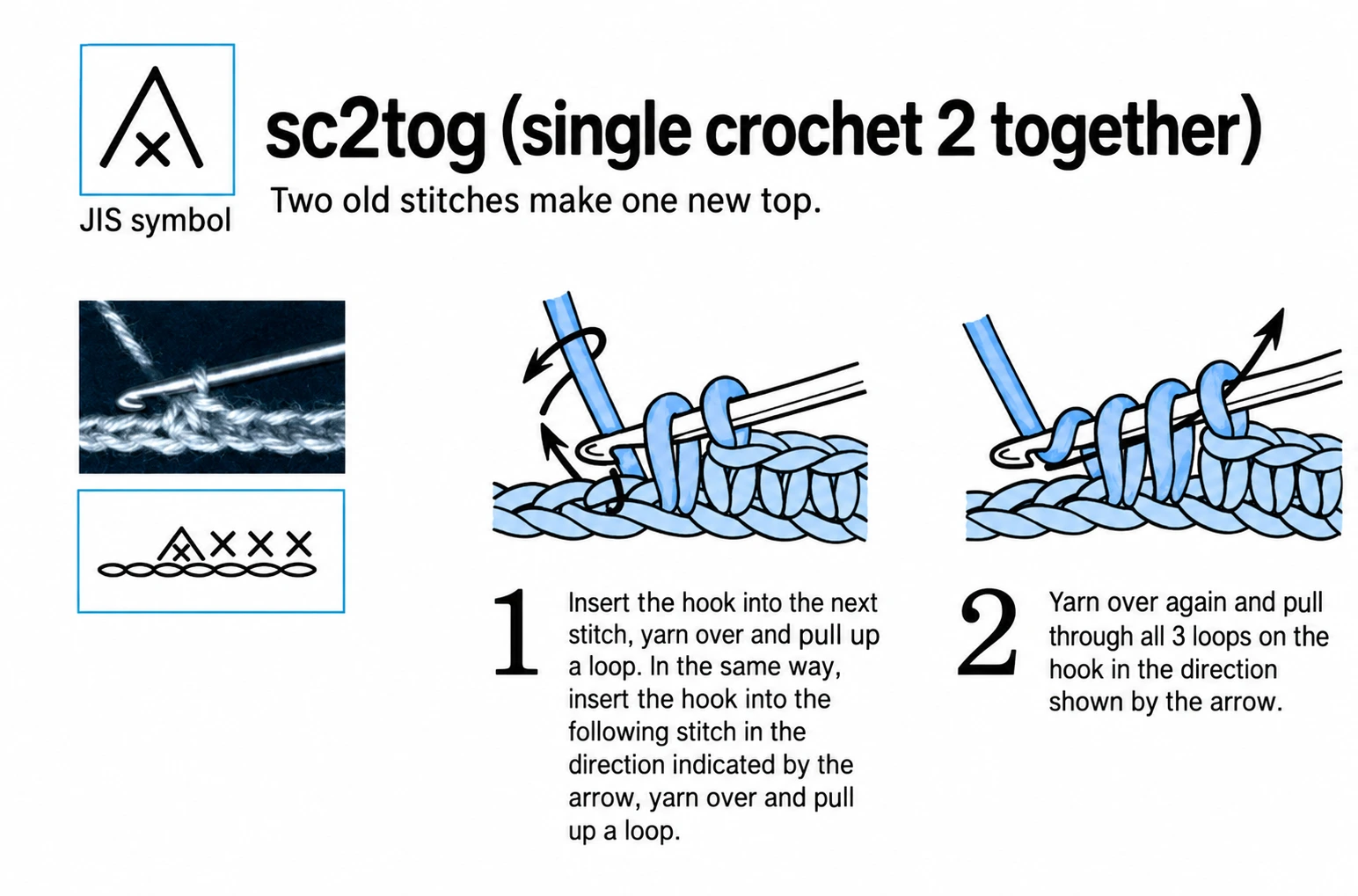
| A | Join 2 sc into one, sc2tog | −1 |
| M | Join 3 sc into one, sc3tog | −2 |
| TV / TW | Work 2 / 3 hdc in one stitch | +1 / +2 |
| TA / TM | Work hdc2tog / hdc3tog | −1 / −2 |
| FV / FW | Work 2 / 3 dc in one stitch | +1 / +2 |
| FA / FM | Work dc2tog / dc3tog | −1 / −2 |
| EV / EW | Work 2 / 3 tr in one stitch | +1 / +2 |
| EA / EM | Work tr2tog / tr3tog | −1 / −2 |
An increase uses one existing stitch and produces several new stitches. A decrease collects several existing stitches into one new top. Count those outputs rather than counting how many times the hook moved.
Special letters need their own key
| Reference | Meaning in the supplied charts |
|---|---|
| BLO / FLO | Back loop only / front loop only |
| NX / NT / NF | Back-post sc / hdc / dc in this reference |
| WX / WT / WF | Front-post sc / hdc / dc in this reference |
| UX / UF | Loop-stitch variants based on sc / dc |
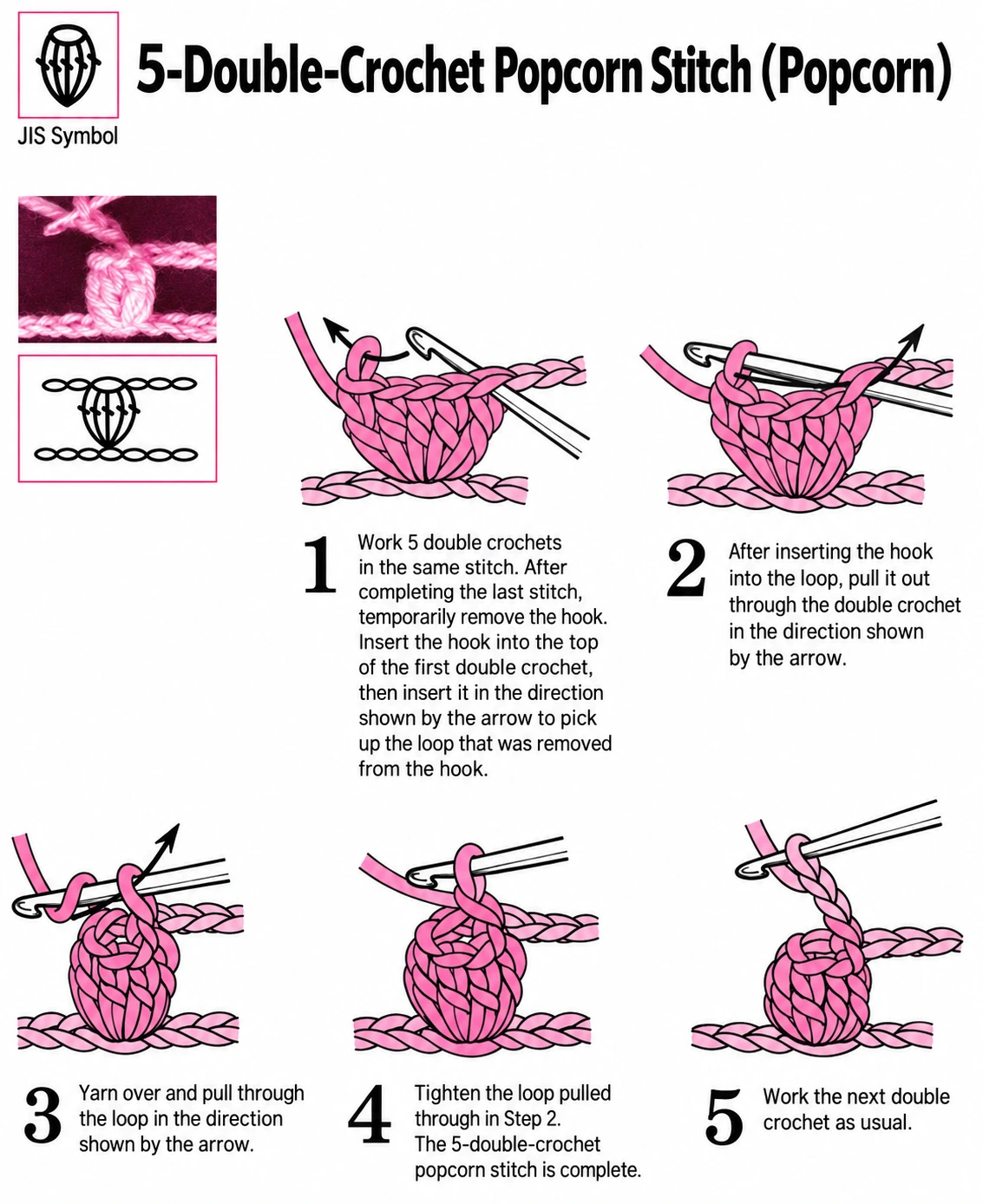
| G | Popcorn; check the number and height of stitches |
| Q | A grouped texture stitch; the exact construction differs between these two charts |
| K | An unworked position or skip; confirm the pattern instruction |
| H | Row count in this reference |
| J | An elongated sc worked into a lower row in this reference |
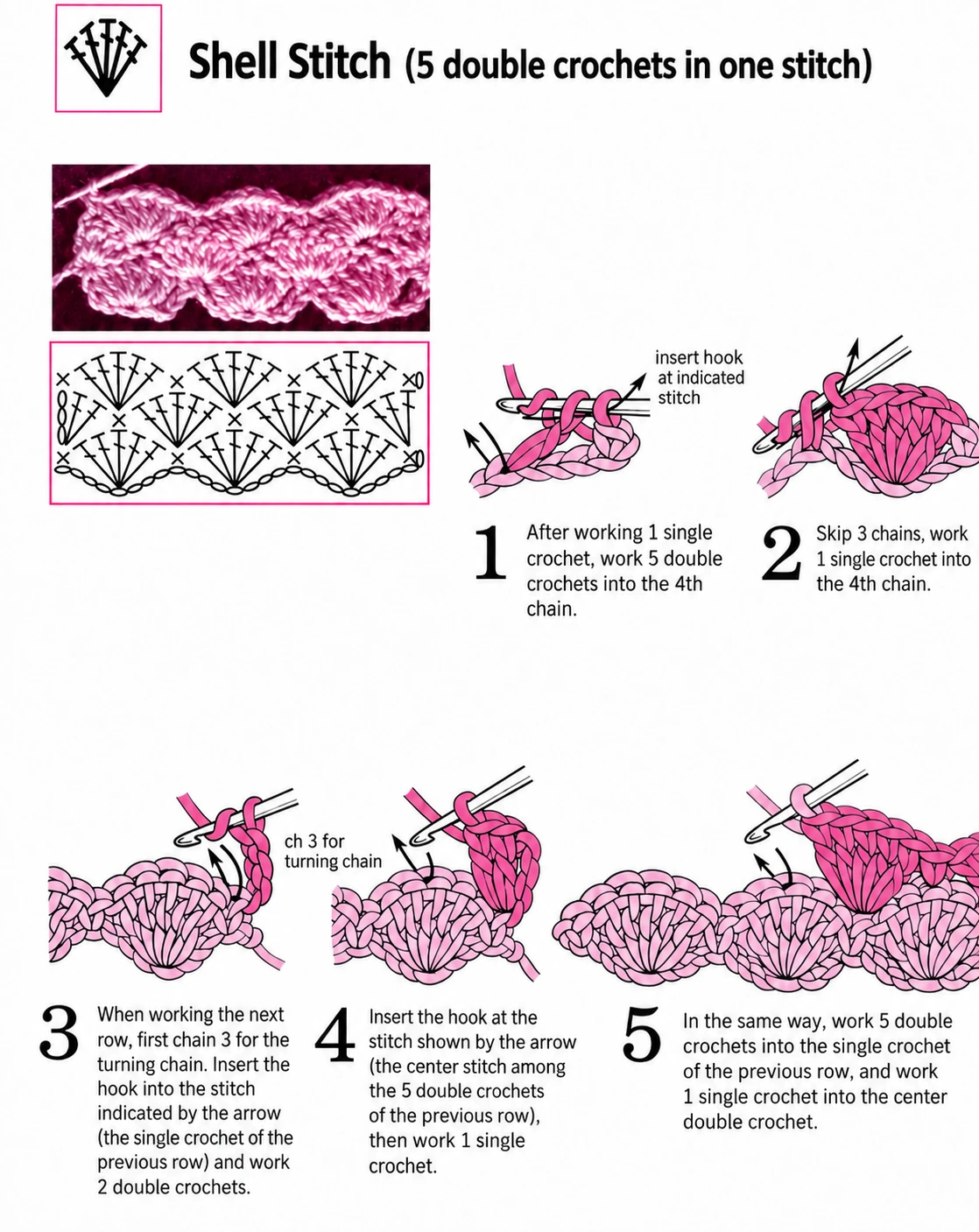
Q needs particular care: one chart describes a three-double-crochet grouped stitch, while the other uses Q for a broader texture category and specifies the component stitches separately. Do not substitute a puff, bobble or cluster just because the letter looks familiar. The star, triangle, omega and arch-shaped picot signs are also designer-specific here.
Translate a whole instruction
In these reference charts, [2F, CH, 2F] means two double crochets, one chain and two more double crochets in the same insertion point. Write that in English as “(2 dc, ch 1, 2 dc) in the same stitch.”
[(T,F)V] puts one half double crochet and one double crochet into the same stitch. [(T,F)A] instead joins a half double crochet and a double crochet across their specified base stitches. The shared starting point and shared finishing point are different ideas.
[(3F)G] specifies a popcorn made from three double crochets in this chart. [(3T)Q] specifies a three-half-double-crochet grouped texture; check how its loops are closed in the accompanying instructions. These details are not supplied by G or Q alone.
The longer example [1CH, (F, Ω)*3, F, 1CH] places one chain, three repetitions of a double crochet plus the chart’s corner-picot instruction, one more double crochet and one final chain in the indicated base. You still need the definition of that corner picot to work it correctly. The other picot symbols distinguish one-chain and three-chain variants and their different closing methods.
Brackets do not always mean “in one stitch.” Other designers use brackets for repeats or stitch totals. Read the sentence around the brackets and the pattern key before beginning.
US and UK names
US single crochet is UK double crochet; US half double crochet is UK half treble; US double crochet is UK treble; and US treble is UK double treble. Yarnumi uses US terms in this guide. Changing the name does not change the physical stitch.
A quick reading routine
- Identify US or UK terminology.
- Check every unfamiliar letter against that pattern’s key.
- Separate the stitch, its insertion point and the repeat count.
- Work a small section and compare its stitch total with the pattern.
Reference notes
Adapted from the supplied Chinese stitch-letter charts and the stitch-symbol section of I Want to Learn Crochet (Chinese-language reference). English names were checked against the Craft Yarn Council abbreviation list. The reference letters above are a translation aid, not a universal alphabet.
Step illustrations and photographs are excerpts from the supplied reference materials credited below. In-image instructional text has been translated into English and the supplied images enhanced with AI assistance. The English captions explain the pictured actions. Select a step image to view it at full size.
Frequently asked questions
What do X, V and A mean in Chinese crochet patterns?
In the supplied notation, X commonly represents single crochet, V an increase and A a decrease. Always check the pattern key because designers can reuse letters differently.
Are Chinese crochet letters the same as US abbreviations?
No. US patterns normally use names such as sc, inc and sc2tog. Treat the chart letter as a designer-specific shorthand, then translate the action.